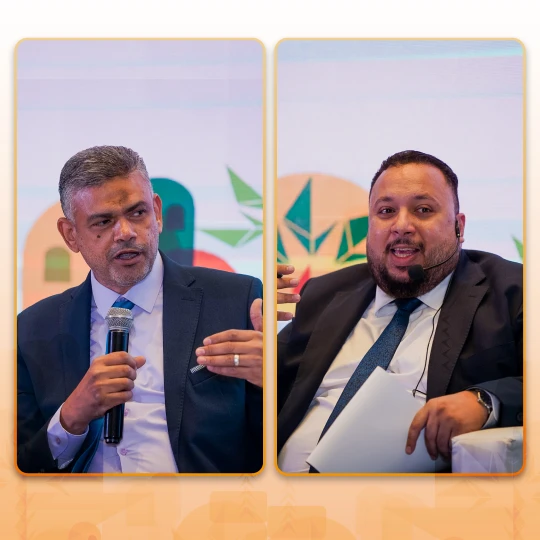
Our first week at the 81st United Nations General Assembly left me with many reflections, but perhaps some of the most interesting conversations were happening beyond the formal UN and government sessions.
Across New York, NGOs, philanthropies, foundations, researchers and businesses were gathering in parallel: debating, challenging assumptions and asking what needs to change if we are serious about delivering development impact at scale.
For the Sawiris Foundation, attending UNGA81 for the first time was about listening and learning, but also contributing our own experience from Egypt.
Throughout the week, we joined three conversations closely connected to our work. We started with the Arab Foundations Forum roundtable on collaborative philanthropy, exploring how locally led philanthropy can move beyond individual projects towards stronger platforms for collaboration and scale. We then joined the OECD netFWD discussion at Education House on philanthropy’s catalytic role in financing education. And we closed the week with our , exploring the opportunities and questions emerging around AI, data and development.
Different rooms, but many of the same questions.
From evidence to scale
One of the highlights for me personally was being in the same room as Dean Karlan, whose work has helped shape global thinking on evidence and poverty reduction, and joining the debate around the Graduation Approach.
The question is no longer simply whether Graduation can work. It is increasingly: how do we take approaches with strong evidence behind them and make them work at scale, through national systems?
That question resonates deeply with our experience in Egypt.
In 2018, the Sawiris Foundation launched Bab Amal, Egypt’s adaptation of the Graduation Approach, with local NGO partners and technical support from BRAC. J-PAL MENA researchers independently evaluated the programme with 3,469 families in Assiut and Sohag, comparing the full programme with a lower-cost version. Our question was practical: Could we adapt an evidence-based model to help families move sustainably out of extreme poverty in Egypt, at a lower cost that could make scale possible?
The results gave us the confidence to go further. More than 14,000 families have now been reached, our Board has committed funding for 50,000 families, and together with the Ministry of Social Solidarity and other partners, the ambition is to reach 100,000 families by 2030.
This is increasingly what evidence-based philanthropy should be about: not simply demonstrating that an individual project works, but asking what it takes for an effective approach to adapt, become more affordable and ultimately reach scale.
Partnership, but with whom?
“Partnership” was probably one of the most frequently used words during the week.
Collaboration. Blended finance. Catalytic capital. Public-private partnerships.
All are important. But I found myself asking a slightly uncomfortable question: are we sometimes preaching to the converted?
The OECD’s latest mapping of private philanthropy gives us reason to ask. Among 311 external partners involved in philanthropic co-financing initiatives in ODA-eligible countries, 38% were other foundations, 26% were private companies and only 7% were domestic or local NGOs.
That matters even more in the current financing environment. Net official development assistance fell 23.3% in 2025, according to preliminary OECD data, and is projected to decline by a further 6.9% in 2026.
As governments, philanthropies, businesses and civil society are asked to think differently about how development is financed, we also need to ask: who is actually at the table?
If locally rooted organizations are expected to implement, innovate and deliver, they should also have a meaningful role in shaping priorities and allocating resources.
Localization cannot simply mean shifting implementation closer to communities. It also has to mean shifting voice, capital and agency.
For a domestic philanthropy such as the Sawiris Foundation, this is particularly relevant. Our role is not simply to fund projects. We can take some of the early risk of testing ideas, generate evidence, convene different actors, co-finance promising approaches and connect global knowledge with local institutions capable of adapting it.
AI is already here
AI was another conversation everywhere we went.
The debate can quickly move between extremes: jobs disappearing, learning being undermined and inequalities widening, or AI allowing communities to leapfrog years of development.
Perhaps the more useful question is: how do we prepare young people for change we cannot fully predict?
Adaptability, critical thinking, data literacy, problem-solving and the ability to continue learning will matter as much as preparing people for any particular job.
And there are harder questions. Could AI help close some of the gaps we have struggled with for decades, including women’s access to decent work and leadership? Could it expand opportunities outside major urban centres? Or will it reproduce existing inequalities?
Fast Forward’s 2025 AI for Humanity Report, supported by Google.org, surveyed nearly 200 nonprofits already exploring how AI can advance their missions. One of its important messages is that realizing AI’s potential requires investment in people, talent and systems, not technology alone.
I was also struck by the UN Data Commons, an initiative of the United Nations Statistics Division supported by Google’s Data Commons and funded by Google.org. It is bringing authoritative UN data into a public platform that can be explored through natural-language search.
Making development data easier to access could be powerful. But as access becomes easier, data quality, interpretation and human judgment become more important, not less.
What does this mean for a domestic philanthropy in Egypt?
Somewhere during the week, I realized that the Sawiris Foundation is already grappling with many of these same questions.
How do we move from evidence to scale? How can philanthropic capital take risks that other forms of financing cannot? How do we learn what works, and have the discipline to change course when something does not? How do we bring government, business, researchers, international partners and local civil society around the same table?
For 25 years, the Sawiris Foundation has been deeply rooted in Egypt’s development ecosystem. That gives us something increasingly valuable: local relationships, institutional knowledge and access to a broad network of local civil society organizations.
We went to New York to listen and learn. But we also found ourselves saying to potential partners: If you want to explore what an idea could look like in Egypt, come talk to us.
We can convene. We can test. We can co-finance. We can generate evidence. And we can help connect global ideas with Egyptian institutions and local realities.
That may be one of the most important roles domestic philanthropy can play as the global financing landscape changes.
From North–South to South–North?
For decades, international development was largely framed through a North–South lens: knowledge, financing and technical expertise flowing from wealthier countries to lower- and middle-income countries.
More recently, South–South cooperation has rightly challenged that model.
But perhaps there is another direction we should take more seriously: South–North learning.
There are models, innovations and lessons emerging from Egypt, Africa and the wider Global South that have relevance far beyond the contexts in which they originated. The question is whether the global development system is equally prepared to listen in that direction.
Our first UNGA left us with a lot to digest, a lot to challenge ourselves on and a lot to bring home.
I am proud to have represented the Sawiris Foundation in New York, alongside other colleagues.
It was our first UNGA. It will not be our last.
The more important question now is not simply how we return next year, but what we will have learned, tested and built in Egypt by the time we do.